Case study 02 · AI / Robotics / Motion Planning
Generative Motion Planning for Robotics
A perception-to-motion pipeline combining stereo calibration, learned trajectory generation, and constrained optimization.
End-to-end
Perception-to-motion research pipeline
Overview
A robotics workflow for predicting and optimizing motion through dynamic, cluttered environments.
Context
Reliable robot manipulation requires perception and learned predictions to connect cleanly with kinematic and dynamic constraints.
My Role
Calibrated an OAK-D Pro stereo camera, developed PyTorch-based generative models, and built the Python trajectory optimization pipeline in Drake's digital twin environment.
Architecture / Approach
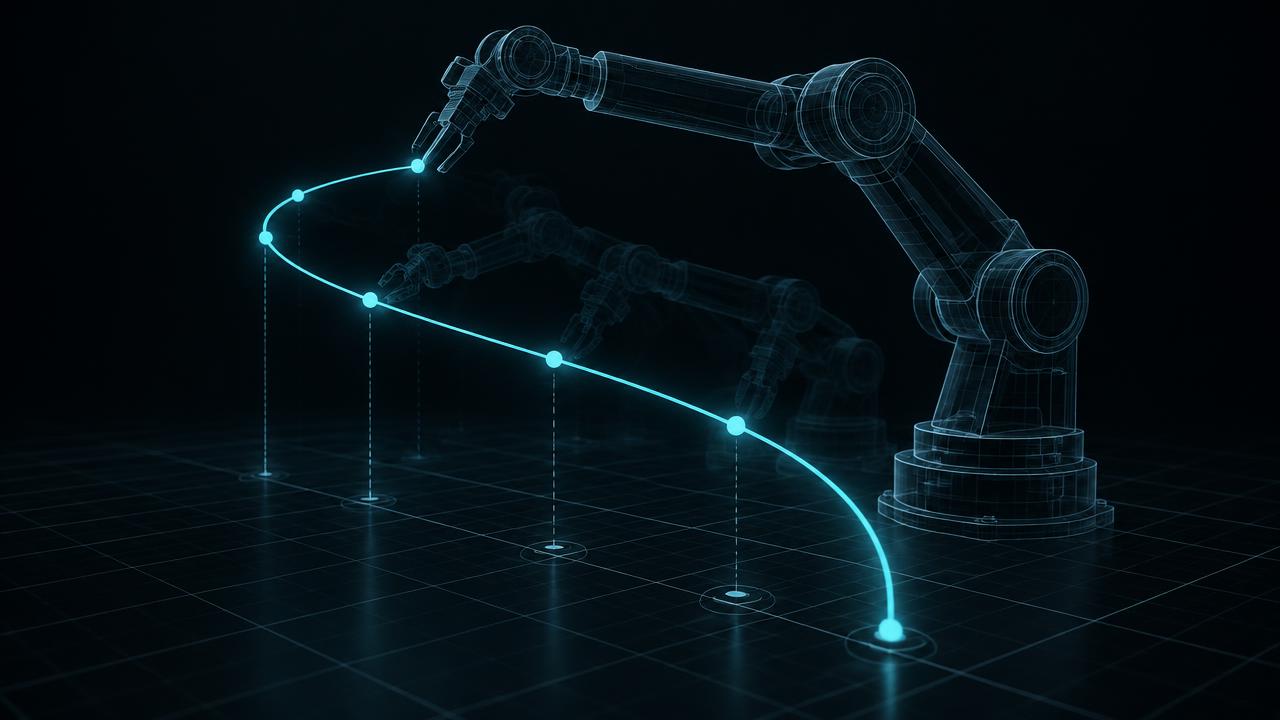
Stereo observations feed perception and a learned model that proposes candidate trajectories before constrained optimization produces robot motion.
- 01Stereo Camera
- 02Perception
- 03Learned Model
- 04Candidate Trajectories
- 05Trajectory Optimization
- 06Robot Motion
Decisions & Tradeoffs
- 01
Learned trajectory proposals refined by constrained optimization
Instead ofAn end-to-end learned control policy
WhyAn end-to-end policy can produce motion that violates joint limits or dynamics constraints with no guarantee of feasibility. Using the model to propose good initial guesses and an optimizer to enforce constraints keeps the speed benefit of learning while keeping every output physically valid.
- 02
Drake for modeling and trajectory optimization
Instead ofMoveIt with sampling-based planners
WhySampling-based planners handle collision-free routing well but treat dynamics as an afterthought. Drake's multibody model and differentiable optimization made it possible to optimize directly against kinematic and dynamic constraints, which is what the research question required.
Outcome
End-to-end
Perception-to-motion research pipeline
Technologies
- Python
- PyTorch
- Drake
- OAK-D Pro
- Computer Vision